
 ChatGPT
 Perplexity
 Gemini
 Claude
 Grok
GrokIf you're planning a glass roof for a terrace, balcony, skylight, pergola, car parking area, or commercial space in Nepal, one of the first questions you'll probably have is how much it will cost.
There isn't one fixed glass roof price in Nepal because the total project cost depends on several factors, including glass type and thickness, roof size, supporting frame, design complexity, transportation, waterproofing, drainage, labour, and installation conditions.
Understanding these costs can make it easier to plan your budget and compare quotations. Whether you're researching glass prices yourself or getting an estimate from a roofing contractor such as Repairing Service Nepal, it is important to look beyond the glass price alone and consider the complete roofing system.
This guide explains the glass roof price in Nepal, including indicative prices per square foot, glass types, installation considerations, factors that affect the final cost, maintenance requirements, and tips for comparing quotations.
Quick Answer: How Much Does a Glass Roof Cost in Nepal?
The glass roof price in Nepal depends on the glass type, thickness, roof size, frame material, design, waterproofing, drainage, transportation, and installation requirements. As an indicative starting point, toughened glass may cost around NPR 700–1,800 per square foot for the glass material alone. A complete installed glass roof will cost more because it also includes the supporting structure, hardware, labour, transportation, waterproofing, drainage, and other project requirements.
These figures are intended for preliminary budgeting, not as fixed market rates. Actual prices can vary by supplier, glass brand, specification, quantity, fabrication requirements, project location, and site conditions.
What Is a Glass Roof?
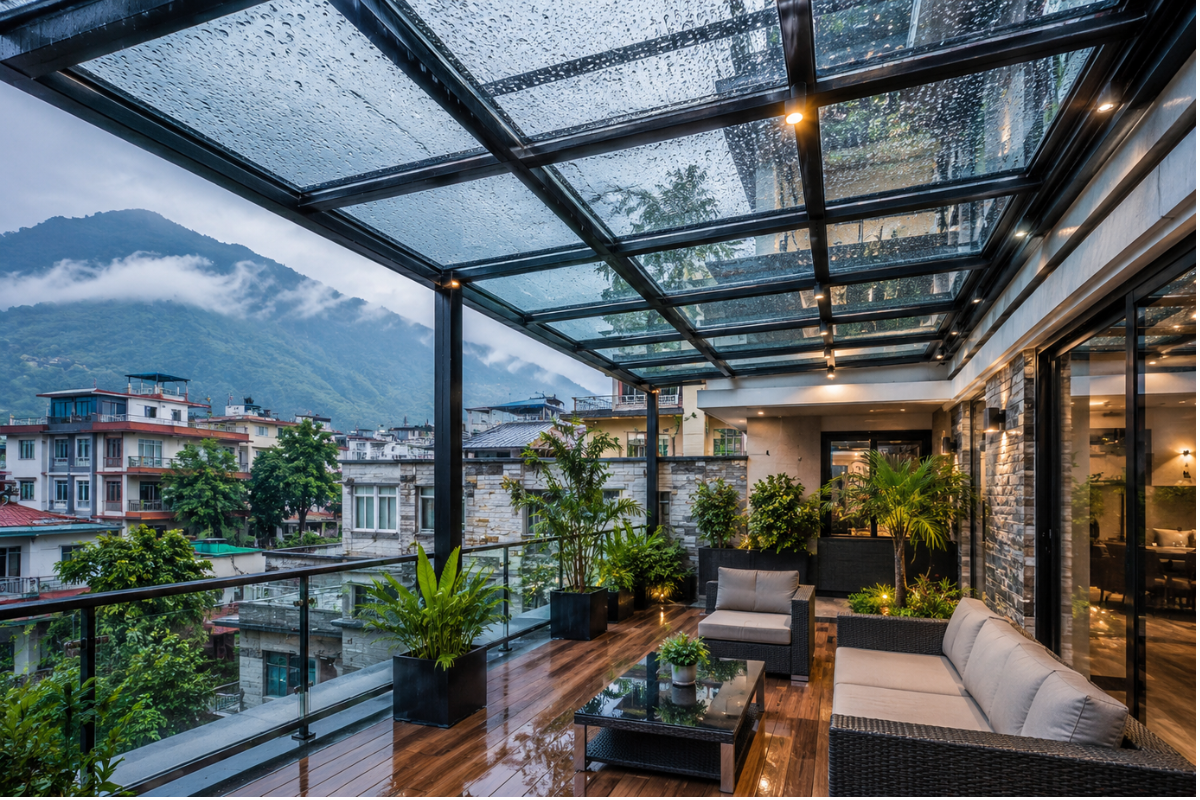
A glass roof is a roofing system made from glass panels supported by a suitable structural frame. It can be used for terraces, balconies, skylights, pergolas, entrances, car parking areas, restaurants, and other residential or commercial spaces.

Glass roofing allows natural daylight into a covered area while providing protection from rain and other weather conditions. Depending on the project, the system may use toughened, laminated, tinted, clear, or solar-control glass.
The glass is typically installed on an aluminium or steel supporting structure with appropriate hardware, seals, waterproofing, and drainage components.
For projects in Nepal, the appropriate roofing system should be determined according to the roof size, span, supporting structure, glass specification, drainage, site conditions, and intended use.
How Much Does a Glass Roof Cost in Nepal?
Glass roofing is often initially estimated according to the price per square foot of glass. However, the glass price represents only one part of the total project cost.
A complete glass roof may also require:
-
Supporting frame
-
Hardware and fittings
-
Transportation
-
Waterproofing and sealing
-
Drainage components
-
Labour and installation
-
Custom fabrication
-
Structural preparation or reinforcement
When requesting a quotation, check whether the quoted price is for glass material only or for a complete installed roofing system.
Quick Glass Roof Price Guide in Nepal
The following are indicative material-only price ranges for toughened glass and should be used as a starting point for budgeting:
|
Glass Thickness |
Indicative Material Price per Sq. Ft. |
Possible Roofing Applications |
|
8 mm |
NPR 700–1,100 |
Smaller or appropriately supported balconies, pergolas and similar applications |
|
10 mm |
NPR 950–1,300 |
Residential terraces, balconies and some canopy applications |
|
12 mm |
NPR 1,300–1,800 |
Larger spans and projects requiring a different glass specification |
Important: These prices refer to the glass material only. The final cost of a glass roof will normally be higher after adding the frame, hardware, transportation, labour, waterproofing, drainage, custom fabrication, and any required structural work.
Glass thickness should not be selected based on price alone. The appropriate specification depends on factors such as panel dimensions, unsupported span, supporting structure, expected loading, glazing system, roof design, drainage, and site conditions.
Because glass prices can vary between suppliers and specifications, request a current, written, itemized quotation before making a purchase or starting installation.
Glass Roof Price Per Square Foot in Nepal
Toughened or tempered glass prices can vary according to thickness, manufacturer, brand, specification, finish, quantity, fabrication requirements, supplier, and location.
The indicative 8 mm, 10 mm, and 12 mm rates are shown in the pricing table above. These figures should be used only as a starting point when preparing a budget.
Pricing note: Glass prices can change depending on supplier, brand, specification, quantity, fabrication requirements, transportation, location, and installation conditions. Always request a current, written and itemized quotation before placing an order.
Is Glass Roof Price the Same as Toughened Glass Price?
No.
Toughened glass price generally refers to the cost of the glass panel itself. The total glass roof price can include many other components required to turn those panels into a complete roofing system.
These may include:
-
Glass panels
-
Aluminium or steel frame
-
Supporting structure
-
Clamps and brackets
-
Bolts and fasteners
-
Sealants and gaskets
-
Waterproofing
-
Drainage components
-
Transportation
-
Labour and installation
-
Structural reinforcement where required
-
Site preparation
-
Custom fabrication
For example, multiplying the price of the selected glass by the roof area gives an estimate for the glass material, not the complete installed roof.
This distinction is important when comparing quotations. One contractor may quote only the glass, while another may provide a complete price covering the frame, installation, sealing, transportation, and other work.
What Is Included in the Cost of a Glass Roof?
The advertised glass rate is only one part of the overall project cost.
Glass Panels
The main material cost comes from the selected glass. Price depends on thickness, type, dimensions, finish, processing, manufacturer, and specification.
Supporting Frame
The roof requires a suitable supporting system. Depending on the design, this may involve aluminium profiles, steel structures, brackets, channels, or other structural components.
Hardware and Fittings
Clamps, brackets, bolts, fasteners, gaskets, spacers, and other fittings may be required to secure the glass appropriately.
Waterproofing and Sealing
Proper sealing around joints and connections is important for reducing the risk of water infiltration.
For a glass roof in Nepal, waterproofing should be considered together with drainage rather than treated as an afterthought.
Drainage
A properly designed roof needs a suitable way for rainwater to drain away. Depending on the design, this may include drainage channels, gutters, flashing, outlets, and other components.
Transportation
Glass requires careful handling during transportation. Large or custom-sized panels may require additional delivery and handling arrangements.
Labour and Installation
Installation may include site measurement, frame installation, glass positioning, sealing, finishing, drainage work, and final inspection.
When comparing quotes, ask whether each of these costs is included or charged separately.
Example: Cost of a 100 Sq. Ft. Glass Roof
Consider a hypothetical 100 sq. ft. glass roof.
If you choose 8 mm toughened glass at an indicative material-only rate of NPR 700–1,100 per sq. ft.:
100 sq. ft. × NPR 700–1,100 = NPR 70,000–110,000
So the glass itself could cost approximately NPR 70,000–110,000 based on the indicative range used in this guide.
However, this is not the final installed roof price.
Additional costs may include:
|
Cost Component |
What It Depends On |
|
Glass |
Thickness, type, brand and specification |
|
Frame |
Aluminium or steel, profile and design |
|
Hardware |
Clamps, brackets and fasteners |
|
Waterproofing |
Sealants, gaskets and drainage |
|
Transportation |
Distance, panel size and site access |
|
Labour |
Installation difficulty and site conditions |
|
Structural work |
Existing structure and reinforcement requirements |
|
Custom fabrication |
Shape, dimensions and special requirements |
|
Total project cost |
Requires a project-specific quotation |
This is why two contractors can quote very different prices for what appears to be the same 100 sq. ft. roof.
Factors That Affect Glass Roof Prices in Nepal

Several factors can influence the final cost of a glass roof.
Glass Thickness
Thicker glass generally costs more per square foot. However, the required thickness should be determined by the roof design, span, support conditions, expected loads, glazing system, and safety requirements rather than simply choosing the cheapest option.
Glass Type
Clear, tinted, laminated, reflective, frosted, and solar-control glass can have different prices depending on their specifications and availability.
Roof Size
A larger roof requires more glass and may also require additional structural support, joints, drainage, and installation work.
Frame Material
Aluminium is lightweight and commonly used for many designs. Steel may be selected where a different structural solution is required.
The choice should be based on the design, span, environment, maintenance requirements, and structural requirements rather than price alone.
Design Complexity
A simple rectangular roof is generally easier to fabricate and install than a curved, multi-angle, irregular, or highly customized structure.
Location and Transportation
Transportation costs can increase when the project is far from the supplier or when large panels require special handling.
Toughened glass is normally cut, drilled, and otherwise processed to the required dimensions before tempering, because conventional cutting or drilling after tempering is generally not possible. Accurate measurements and careful transportation are therefore particularly important.
Installation and Site Access
High roofs, difficult access, complex structures, lifting requirements, and additional site preparation can increase labour and installation costs.
Roof Slope and Drainage
A glass roof should be designed with appropriate slope and drainage so rainwater can flow away rather than remain on the roof.
Drainage channels, gutters, flashing, outlets, and sealing details can all affect the overall project cost.
Glass Brand and Quality
Glass from different manufacturers or suppliers may vary in quality, specifications, processing, documentation, warranty, and price.
Two panels with the same thickness are not necessarily identical products.
When comparing glass prices, check:
-
Manufacturer or brand
-
Glass type
-
Thickness
-
Processing
-
Quality documentation
-
Certification where applicable
-
Warranty terms
-
Supplier reputation
-
Availability of replacement panels
A lower price is not automatically better if the product specification or supporting components are different.
Does Tinted or Colored Glass Cost More?
It can.
Clear glass is generally the simplest option, while tinted, colored, reflective, or solar-control glass may cost more depending on its specification, thickness, brand, coating, and availability.
Tinted glass can be useful when you want to reduce glare or control the amount of direct sunlight entering the covered area.
Depending on the project, you may consider:
-
Clear glass
-
Grey tinted glass
-
Bronze tinted glass
-
Reflective glass
-
Solar-control glass
-
Frosted or privacy glass
When comparing quotations, do not compare only the thickness. Two 10 mm panels, for example, can have different specifications and therefore different prices.
Does Custom Glass Increase the Price?
Yes, custom requirements can increase the total cost.
Standard rectangular panels are generally easier to manufacture and install. Custom shapes, unusual dimensions, cut-outs, drilled holes, special edges, and complex roof designs can require additional fabrication and installation work.
Toughened glass needs to be cut and processed before tempering. Once the glass has been toughened, it generally cannot be resized through ordinary cutting.
This makes accurate measurement particularly important for custom glass roofs. Incorrect measurements may require a replacement panel rather than an adjustment at the installation site.
Types of Glass Used for Roofing
Different glass types can be considered depending on the roof design, safety requirements, appearance, and level of solar control required.

Toughened Glass
Toughened glass, also called tempered glass, is heat-treated to increase its strength compared with ordinary annealed glass.
It is commonly considered for terraces, balconies, canopies, pergolas, and similar applications.
However, toughened glass should not automatically be treated as suitable for every overhead application. The complete glazing and structural system needs to be assessed for the intended use.
Laminated Glass
Laminated glass consists of multiple glass layers bonded with an interlayer.
If the glass cracks, the interlayer can help retain the broken pieces. This can make laminated glass an important consideration for certain overhead applications where post-breakage retention is particularly important.
Tinted Glass
Tinted glass can reduce glare and control the amount of sunlight entering a covered area.
Reflective or Solar-Control Glass
These products are designed to reduce solar heat transmission or glare depending on their specific construction and coating.
Clear Glass
Clear glass allows a high amount of natural light through and provides an open visual appearance.
There is no single glass type that is best for every roofing project. The final selection should consider span, support, loading, roof design, safety requirements, sunlight exposure, glazing system, and local conditions.
For more information about toughened glass roofing, see our complete guide to toughened glass roofs.
Glass Roof Installation Cost in Nepal
Glass installation is a separate cost in many roofing projects.
Installation work may include:
-
Site inspection and measurement — checking dimensions and existing structural conditions
-
Frame installation — installing and anchoring the aluminium or steel supporting structure
-
Glass installation — positioning and securing the pre-cut panels
-
Sealing and waterproofing — applying appropriate sealants and gaskets
-
Drainage and finishing — checking slope, drainage channels, joints, and finishing details
-
Final inspection — checking the installation, seals, drainage, and visible workmanship
The actual installation cost depends on the roof size, height, access, frame design, existing structure, preparation requirements, and project complexity.
Recent Nepal service listings also illustrate that some providers quote inspection or installation separately rather than treating installation as part of the basic glass price.
Does the Glass Roof Price Include Installation?
Not necessarily.
Always ask whether the quoted price covers:
-
Glass material
-
Frame
-
Hardware
-
Transportation
-
Labour
-
Waterproofing and sealing
-
Drainage
-
Structural preparation
-
Custom fabrication
-
Site preparation
A quotation should clearly state what is included so you can compare contractors fairly.
For Nepal's monsoon conditions, proper sealing, drainage, and waterproofing are particularly important. Waterproofing around roof connections and drainage points can help reduce the risk of water infiltration.
You can also explore our roof waterproofing resources for related information.
Where to Buy Glass Roof Materials in Nepal
Glass roof materials can be sourced through glass suppliers, fabricators, construction-material dealers, and contractors in Nepal.
Kathmandu Valley generally offers a wider selection of glass products and fabrication services, but buyers should still compare specifications rather than choosing a supplier based only on price.
When contacting a supplier or contractor, ask about:
-
Glass type
-
Glass thickness
-
Manufacturer or brand
-
Toughened or laminated specification
-
Available panel sizes
-
Edge finishing
-
Tint or coating
-
Frame material
-
Hardware and fittings
-
Delivery charges
-
Fabrication charges
-
Installation availability
-
Warranty
-
Product documentation
If the project is outside Kathmandu Valley, confirm whether the supplier provides delivery and installation in your location and whether transportation or handling charges will be added.
For larger or customized projects, comparing complete project quotations can be more useful than buying glass separately and arranging installation independently.
Glass Roof Applications

Glass roofs can be used for a variety of residential and commercial applications.
Terrace Glass Roof
A glass roof can provide weather protection while allowing natural light into a terrace area.
Balcony Glass Roof
Glass balcony roofing can provide protection from rain while maintaining an open appearance.
Skylight
A skylight can introduce natural light into rooms, staircases, corridors, and other areas.
For overhead glazing where falling-glass risk needs particular consideration, the glazing specification and post-breakage behaviour should be assessed carefully.
Glass Pergola
Glass can make an outdoor pergola more usable during rainy weather while maintaining a modern appearance.
Glass Car Parking Roof
Glass roofing can be used for car parking areas where natural light and appearance are important.
Restaurants and Cafes
Glass roofs can provide weather protection for outdoor seating while retaining daylight.
Commercial Entrances and Atriums
Glass roofing can create a modern entrance or architectural feature for commercial properties.
Benefits of Glass Roofing
Some potential benefits include:
-
Brings natural daylight into covered spaces
-
Provides a modern and premium appearance
-
Can protect outdoor areas from rain
-
Can make terraces and balconies more usable
-
Can provide an open visual appearance
-
Offers different options for light and solar control
-
Can complement modern residential and commercial designs
The actual benefits depend on the design, glass specification, frame, installation quality, climate, and how the space is intended to be used.
Disadvantages of Glass Roofing
Glass roofing also has limitations that should be considered before installation.
Higher Initial Cost
Glass generally costs more upfront than basic metal sheets and may cost more than some polycarbonate systems.
Heat and Glare
A glass roof can allow significant sunlight into a space. Without suitable glass, shading, ventilation, or solar-control measures, the area may become uncomfortable during hot periods.
Professional Installation
Accurate measurement, suitable structural support, sealing, drainage, and safe glass handling are important.
Limited On-Site Modification
Toughened glass generally cannot be cut after tempering, so incorrect measurements can result in replacement panels.
Panel Replacement
A significantly damaged glass panel will generally need to be replaced rather than repaired like some sheet-roofing materials.
Glass Roof vs Polycarbonate vs Metal Roofing
Before choosing glass, it is useful to compare it with other common roofing materials.
|
Feature |
Glass Roof |
Polycarbonate Roof |
CGI/Metal Sheet |
|
Natural light |
Excellent |
Good to excellent depending on sheet |
Limited |
|
Upfront cost |
Generally higher |
Generally lower |
Generally lower |
|
Appearance |
Modern/premium |
Practical |
Functional |
|
Weight |
Relatively heavy |
Lightweight |
Relatively lightweight |
|
Heat control |
Depends on glass specification |
Depends on sheet specification |
Depends on insulation and coating |
|
Maintenance |
Cleaning and periodic checks |
Cleaning and periodic checks |
Rust/coating checks where applicable |
|
Typical use |
Premium terraces, canopies, skylights |
Lightweight light-transmitting roofs |
Practical roofing |
The best material depends on the project requirements rather than price alone.
Glass Roof vs Polycarbonate Roof: Which Is Better?
Glass and polycarbonate are both options for roofs where natural light is important, but they offer different advantages.
Glass may be preferred when appearance, transparency, durability, and a premium architectural finish are priorities. It can be suitable for terraces, balconies, skylights, pergolas, and commercial spaces when the supporting structure and glazing system are properly designed.
Polycarbonate is lightweight and can be more economical for projects where reducing structural weight and upfront cost is important. Different polycarbonate sheets can also offer different levels of light transmission, heat control, and durability.
The better option depends on:
-
Budget
-
Structural requirements
-
Appearance
-
Roof size
-
Heat-control requirements
-
Intended use
-
Maintenance expectations
-
Long-term project goals
For a premium architectural appearance, glass may be preferable. For a lightweight and potentially more budget-friendly light-transmitting roofing solution, polycarbonate may be worth considering.
Glass Roof vs Metal Roofing
Metal or CGI roofing is commonly selected when keeping upfront roofing costs low is a priority.
Glass, on the other hand, can provide natural daylight and a more open architectural appearance.
|
Factor |
Glass Roof |
Metal Roof |
|
Natural light |
Excellent |
Limited |
|
Initial cost |
Higher |
Generally lower |
|
Appearance |
Modern/premium |
Practical |
|
Rain noise |
Depends on system |
Can be noticeable |
|
Maintenance |
Glass and seals require inspection |
Coating/rust and fasteners require inspection |
|
Best suited for |
Daylight-focused architectural spaces |
Practical weather protection |
How to Choose the Right Glass Roof for Your Property
Before requesting quotations, consider the following.
1. Define the Purpose
Decide whether the roof is for a terrace, balcony, skylight, canopy, pergola, car parking area, or commercial space.
2. Measure the Span
Roof dimensions and unsupported spans can influence the supporting structure and glass specification.
3. Choose the Frame Material
Discuss whether aluminium, steel, or another structural solution is appropriate for the design.
4. Plan Drainage
The roof should have suitable slope and drainage provisions to prevent water accumulation.
5. Select the Glass Type
Depending on the project, you may consider toughened, laminated, tinted, or solar-control glass.
6. Consider Custom Requirements
Unusual shapes, dimensions, holes, cut-outs, and other fabrication requirements can increase the cost.
7. Separate Your Budget
Consider glass, frame, hardware, transportation, labour, waterproofing, drainage, and any structural work separately.
8. Consider Glass Brand and Quality
Do not compare only the thickness or price. Check the manufacturer, specification, processing, quality documentation, warranty, and supplier reputation.
9. Get Professional Advice
The final glass and structural specification should be based on the actual site, roof design, support conditions, drainage, and safety requirements.
Professional Recommendation: Do not select glass thickness solely based on price. The appropriate roofing system should be assessed based on the roof design, span, supporting structure, loading, drainage, glazing system, and site conditions. For overhead applications, the glass and supporting structure should be properly assessed before installation.
How to Compare Glass Roof Quotes in Nepal
Getting multiple quotations is useful, but comparing only the price per square foot can give you the wrong impression.
Ask every contractor to provide an itemized quotation.
|
Quotation Item |
What to Check |
|
Glass |
Type, thickness, brand and specification |
|
Frame |
Material, profile and finish |
|
Hardware |
Clamps, brackets and fasteners |
|
Waterproofing |
Sealants, gaskets and drainage |
|
Transportation |
Delivery and handling charges |
|
Labour |
Installation and site preparation |
|
Custom work |
Special shapes, drilling and fabrication |
|
Structural work |
Reinforcement or additional support |
|
Warranty |
Coverage and duration |
|
Total |
Complete installed project price |
For example, a contractor offering a lower glass rate may still have a higher overall quotation if the frame, transportation, waterproofing, or labour is excluded.
The best comparison is therefore based on the complete installed specification, not simply the lowest per-square-foot price.
Glass Roof Maintenance and Long-Term Costs
A glass roof does not normally require complicated daily maintenance, but regular inspection can help identify small problems before they become expensive repairs.
Routine maintenance may include:
-
Cleaning dust, dirt, and water marks
-
Checking sealants and gaskets
-
Inspecting drainage channels
-
Checking for water leakage after heavy rain
-
Inspecting frame joints and fasteners
-
Removing leaves and debris from drainage points
-
Checking for cracks or visible damage
The initial installation cost is only one part of the long-term expense.
When comparing roofing systems, consider possible costs such as:
-
Regular cleaning
-
Sealant replacement
-
Drainage maintenance
-
Hardware replacement
-
Frame maintenance
-
Damaged panel replacement
A cheaper initial system is not necessarily cheaper over its entire service life if it requires more frequent repairs or maintenance.
Common Glass Roof Problems and What to Check
Glass Roof Leakage
Leaks can occur because of failed seals, poorly detailed joints, inadequate flashing, drainage problems, or installation issues.
The affected area should be inspected to identify the source rather than simply applying sealant over visible water.
Glass Roof Condensation
Condensation can form when warm, moist air comes into contact with a colder glass surface.
Improving ventilation and considering appropriate glass or building-design solutions can help depending on the cause.
Glass Roof Heat
A glass roof can increase solar heat gain depending on its orientation, glass specification, and surrounding ventilation.
Possible approaches include solar-control glass, suitable shading, blinds, ventilation, or other heat-management measures.
Glass Roof Drainage Problems
Water pooling can indicate inadequate slope, blocked drainage channels, poor detailing, or another design or maintenance issue.
Drainage should be checked regularly and kept free of leaves and debris.
Glass Roof Cracks or Damage
A damaged panel should be assessed promptly. Do not attempt to modify or cut toughened glass on site.
Depending on the damage and glazing system, the affected panel may need to be replaced.
How to Get an Accurate Glass Roof Quote in Nepal
For a quotation that is useful for comparison, provide the contractor with as much project information as possible.
This may include:
-
Roof length and width
-
Project location
-
Preferred glass type and thickness, if known
-
Frame material preference
-
Roof shape and design
-
Clear or tinted glass preference
-
Custom dimensions or shapes
-
Existing structural details
-
Photos of the installation area
-
Access conditions
For a firm project price, a site inspection is often necessary.
Measurements, structural conditions, access, drainage, transportation, and installation requirements can significantly affect the final quotation.
Glass Roof Installation in Kathmandu
For projects in Kathmandu, Lalitpur, and Bhaktapur, the final specification should be based on the actual site rather than choosing a glass thickness solely from a price list.
Important considerations include:
-
Glass specification
-
Supporting frame
-
Structural support
-
Roof slope
-
Drainage
-
Sealing and waterproofing
-
Site access
-
Installation conditions
-
Transportation and handling
Toughened glass is generally processed to its required dimensions before tempering, making accurate site measurement particularly important.
If you're planning a glass roof for a terrace, balcony, skylight, or commercial space in Kathmandu Valley, contact Repairing Service Nepal to discuss your project and request an itemized quotation.
Glass Roof Installation Outside Kathmandu Valley
Glass roof projects outside Kathmandu Valley may involve additional transportation and installation considerations.
Delivery costs can vary depending on:
-
Distance
-
Road access
-
Panel size
-
Handling requirements
-
Project location
-
Availability of installation teams
The availability of experienced glass installers may also vary by area. For projects outside Kathmandu Valley, confirm in advance whether the supplier or contractor provides delivery, fabrication, and installation in your location.
Site access is another important consideration. Difficult roads, limited access to the building, building height, lifting requirements, and remote locations may affect the overall project cost and installation schedule.
For this reason, an outside-Kathmandu quotation should ideally identify material, transportation, installation, and site-related costs separately.
Frequently Asked Questions About Glass Roof Price in Nepal
How much does a glass roof cost per sq. ft. in Nepal?
The glass itself may be priced per square foot, but the complete roof cost also includes the frame, hardware, waterproofing, drainage, transportation, labour, and installation. The indicative toughened-glass material rates in this guide range from approximately NPR 700–1,800 per sq. ft., depending on thickness.
What is the price of 8 mm toughened glass in Nepal?
The indicative material-only price used in this guide is approximately NPR 700–1,100 per sq. ft. Actual prices can vary by supplier, brand, specification, quantity, fabrication, and location.
What is the price of 10 mm toughened glass in Nepal?
The indicative material-only price used in this guide is approximately NPR 950–1,300 per sq. ft. Request a current quotation for the exact glass specification you need.
What is the price of 12 mm toughened glass in Nepal?
The indicative material-only price used in this guide is approximately NPR 1,300–1,800 per sq. ft. The final roofing cost will be higher if framing, hardware, waterproofing, transportation, labour, and installation are included.
Does the glass roof price include installation?
Not necessarily. Some suppliers quote glass material separately from installation, while contractors may provide a complete project quotation. Always ask for an itemized quotation showing glass, frame, hardware, transportation, labour, waterproofing, drainage, and other costs.
Is 12 mm glass suitable for roofing?
12 mm glass may be considered for some roofing applications, but thickness alone does not determine whether a roof is safe or suitable. The appropriate specification depends on the panel dimensions, span, support conditions, loading, glazing system, roof design, drainage, and site conditions.
Which glass is suitable for a terrace roof?
Depending on the design, toughened or laminated glass may be considered for terrace roofing. The appropriate choice depends on the structural system, span, loading, safety requirements, solar exposure, and intended use of the space.
Where can I buy glass roofing materials in Nepal?
Glass roofing materials can be sourced through glass suppliers, fabricators, construction-material dealers, and roofing contractors. Kathmandu Valley generally has a wider selection, but buyers should compare product specifications, manufacturer or brand, processing, delivery, installation, and warranty rather than choosing solely by price.
What affects the final glass roof installation cost?
The final cost can be affected by glass thickness and type, brand and quality, roof size, frame material, design complexity, transportation, site access, waterproofing, drainage, labour, custom fabrication, and structural preparation.
Professional Service for Glass Roof Projects in Nepal
Repairing Service Nepal provides roofing and building-related services for residential and commercial properties.
For a glass roof project, the final cost should be based on the actual site, measurements, roofing design, glass specification, supporting structure, drainage, waterproofing, transportation, and installation requirements.
Instead of relying only on a per-square-foot material price, property owners can request an itemized project quotation that separates the major cost components.
If you are planning a terrace, balcony, skylight, pergola, car parking roof, or commercial glass roofing project, contact Repairing Service Nepal to discuss your requirements and request a project-specific estimate.
Conclusion
There is no single fixed answer to “how much does a glass roof cost in Nepal?”
The final price depends on factors such as glass thickness and type, glass brand and quality, roof size, frame material, design complexity, custom requirements, transportation, waterproofing, drainage, and installation.
When comparing options, do not look only at the glass price per square foot. Ask for an itemized quotation that clearly shows the cost of the glass, frame, hardware, transportation, labour, waterproofing, drainage, and any additional structural work.
It is also important to consider long-term maintenance and make sure the selected glass and supporting structure are appropriate for your specific roof design and site conditions.
For overhead applications, glass thickness should never be selected solely because it is cheaper or thicker. The complete roofing and glazing system should be assessed according to the span, support structure, loading, drainage, design, and safety requirements.
If you're ready for a project-specific estimate, contact Repairing Service Nepal to discuss your terrace, balcony, skylight, pergola, or commercial glass roof and request an itemized quotation.